


.jpg?width=1050&height=525&name=Two-Company%20Theorem%20(4).jpg)
Every operating company that owns its real estate is, financially, two companies. The mistake is selling them as one.
A $30 million company sells for $30 million. Simple enough. Except it isn't. Because buried inside that company - under the accountant's balance sheet, past the operating model, beneath the line items your investment banker is reviewing right now - is a second company. One that trades at a completely different multiple. One that, when separated from the operating business, can add $3 million, $5 million, or $7 million to the total proceeds. Without a single change to the business you built.
This is the Two-Company Theorem. It applies to every operating company that owns the real estate it operates from. And the reason most owners never collect on it is not complexity - it is that nobody at the table has been asked to look for it.
This article explains why the theorem holds, how the math works, and what you need to do before your next sale process starts.
The Two-Multiple Problem
When a buyer underwrites your business, they apply one multiple to one set of earnings. That multiple reflects the risk profile of your operating business - the industry you're in, your customer concentration, your EBITDA margins, your growth trajectory. For a middle-market industrial services company, that might be 6× EBITDA. For a healthcare-adjacent services business, maybe 9×. The multiple is a judgment about operating risk.
Now consider what happens when that same business also owns the building it operates from. The property's earnings - the implied rent that never appears on the P&L because you own it - are not operating earnings. They're real estate earnings. And real estate trades at a completely different risk profile: stable, long-duration, secured by hard assets. In the current market, a well-leased industrial property might trade at a 6.5% cap rate, which is the equivalent of roughly 15× net operating income.
Here is the problem. When you sell the company as a single entity, the buyer prices everything at the operating business multiple. The real estate - which could command a 15× multiple on its own - gets quietly valued at 8× because it is wrapped inside an 8× company. You leave the spread on the table.
"The property isn't being valued at what a real estate investor would pay for it. It's being valued at what your operating business is worth. Those are not the same number."
Why the Market Clears at the Wrong Price
The natural response is: "Surely the buyer accounts for the real estate value." Sometimes they do, imperfectly, in the form of a real estate adjustment in the purchase price. But this is not the same as the market clearing at two separate valuations. Here is why.
A strategic buyer acquiring your company is buying operational synergies, customer relationships, and revenue. They are not a real estate investor. They will not underwrite the property as a standalone asset - they will underwrite it as a component of a transaction they are already doing for other reasons. Which means they will not pay for the full optionality of the real estate, because extracting that optionality (executing a sale leaseback after close) is work, risk, and capital they weren't planning to deploy.
A private equity buyer faces a similar constraint. They are optimizing for their return model, which is built around the operating business. The real estate is an asset on the balance sheet - a nice-to-have, not the thesis. A well-disciplined PE firm will underwrite the SLB opportunity at close, but many won't, and even those that do won't price it into the bid at full value because it remains execution risk until it is executed.
The result: in almost every unstructured sale process, the real estate is implicitly valued at the company multiple. The seller absorbs the discount. The buyer captures the upside after close.
The fix is to execute the bifurcation before the sale process starts - not after. Run the sale leaseback while you still own both companies. Sell the property to a real estate investor at real estate prices. Sell the operating business, now asset-light and structurally cleaner, to a financial or strategic buyer at operating business prices. Collect the proceeds from both transactions.
Lease Structure as Bifurcation Tool
A sale leaseback is the mechanism that makes bifurcation possible without disrupting operations. The transaction structure is straightforward: you sell the property to a real estate investor and simultaneously execute a long-term lease that gives you the right to continue operating from that property - as a tenant. Nothing changes for your employees, your customers, or your operations. You are still in the building. You simply no longer own it.
The lease that governs the relationship between PropCo (the new property owner) and OpCo (your operating business) is typically a triple-net lease, often abbreviated NNN. This is an important point that many owners misunderstand when they first hear about it.
What a Triple-Net Lease Actually Says About Control
A triple-net lease means the tenant (you, as OpCo) is responsible for property taxes, insurance, and maintenance. In practice, for owner-operated businesses, this is not a change - you were already paying all of those things as the owner. What the lease structure adds is: a fixed or modestly escalating rent obligation in exchange for a long-term right of occupancy, typically 15 to 20 years with renewal options.
The critical thing owners need to understand: a well-structured NNN lease gives the tenant extraordinary operational control. You decide when to renovate. You decide what signage to run. You decide when to expand or reconfigure. The landlord's interest is the income stream - they are a passive capital provider, not a property manager. Provided you pay rent, the building is functionally yours to operate.
This is the fact that resolves the most common objection to the Two-Company Theorem. The objection is: "I don't want to sell the building because I'll lose control." The response is: a triple-net lease does not transfer control. It transfers ownership. They are not the same thing, and conflating them is the most expensive mistake an owner can make before a liquidity event.
Worked Example: $30M Company, Two Outcomes
Let's make the math concrete. Consider a manufacturing services business with the following profile:
- EBITDA: $3.75 million (trailing twelve months)
- Real estate: 45,000 sq ft industrial facility, owned, fair market value $8 million
- Implied rent: $560,000 annually (7% cap rate on the property value)
- Industry trading multiple: 8× EBITDA
Scenario A: Traditional Single-Entity Sale
The investment banker runs a traditional M&A process. The company sells for 8× EBITDA on the full $3.75 million - $30 million. The real estate, included in the enterprise, is implicitly valued at the operating multiple rather than as a standalone asset. Total proceeds: $30 million.
Scenario B: Pre-Exit Sale Leaseback + OpCo Sale
Prior to the M&A process, the owner executes a sale leaseback on the property at a 7% cap rate. The $560,000 implied rent yields a property valuation of $8 million. The owner receives $8 million in proceeds and executes a 20-year NNN lease.
Post-SLB, the operating business now carries $560,000 in annual rent expense. EBITDA adjusts to $3.75M - $0.56M = $3.19 million. The company remains an 8× business - the rent is a legitimate operating expense that a buyer would underwrite in the asset-light structure - and sells for $3.19M × 8 = $25.5 million.
Total proceeds in Scenario B: $8.0M (PropCo) + $25.5M (OpCo) = $33.5 million.
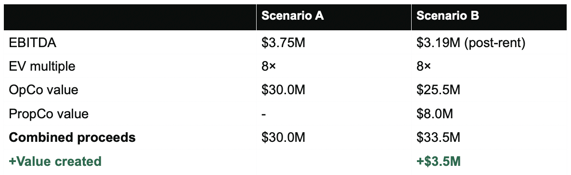
That $3.5 million did not require operational change. It did not require a better business. It required a different transaction structure - one that lets each asset find the buyer best positioned to pay for it.
In deals where the real estate represents a higher proportion of enterprise value, or where the gap between operating multiples and cap rates is wider, the lift is more significant. We have seen bifurcated structures deliver 15% to 22% more in total proceeds than the single-entity equivalent.
When the Theorem Fails
The Two-Company Theorem is not universally applicable. A framework earns credibility by being honest about the cases where it does not apply.
The rent coverage ratio is too thin
A sale leaseback only works if the operating business can credibly support the rent obligation. Real estate investors - particularly institutional net-lease buyers - underwrite the tenant's ability to pay, not just the property's value. If post-rent EBITDA coverage falls below 2×, the transaction becomes difficult to execute at favorable pricing. Run the coverage math before assuming the theorem applies.
The property is functionally impaired
Highly specialized facilities - purpose-built industrial plants, cold-storage assets with significant owner-specific modifications, single-use structures - trade at compressed cap rates because the universe of replacement tenants is narrow. The real estate multiple advantage narrows or disappears. The theorem requires a property that a real estate investor can underwrite as a going-concern lease on its own merits.
The M&A buyer needs the real estate
In some strategic transactions - particularly where the buyer is acquiring for real estate access in a supply-constrained market - the real estate may have higher strategic value inside the transaction than it would command as a standalone lease. This is unusual but not rare in dense urban markets. It requires a judgment call, not a formula.
The timing does not work
The theorem requires sequencing: PropCo sale before OpCo sale. This adds 60 to 90 days to the pre-exit preparation timeline. If a sale process is already in motion or under a hard deadline, bifurcation may not be executable. The optimal window to evaluate it is 12 to 18 months before a planned exit - not at the point of banker engagement.
The Question Most Owners Were Never Asked
Every owner who has sold a business that owned its real estate has, whether they knew it or not, made a decision about the Two-Company Theorem. Most made it by default - nobody raised it, so it wasn't considered. A few made it deliberately and captured the value.
The question is not whether you have two companies. If you own the building your business operates from, you do. The question is whether you sell them as one - and absorb the discount - or sell them separately and capture the spread.
That decision belongs to you. The only way to make it is to understand the numbers.
"The most valuable thing we can do for an owner is show them the balance sheet they've never been handed: the one that separates the building from the business."



Leave a Comment